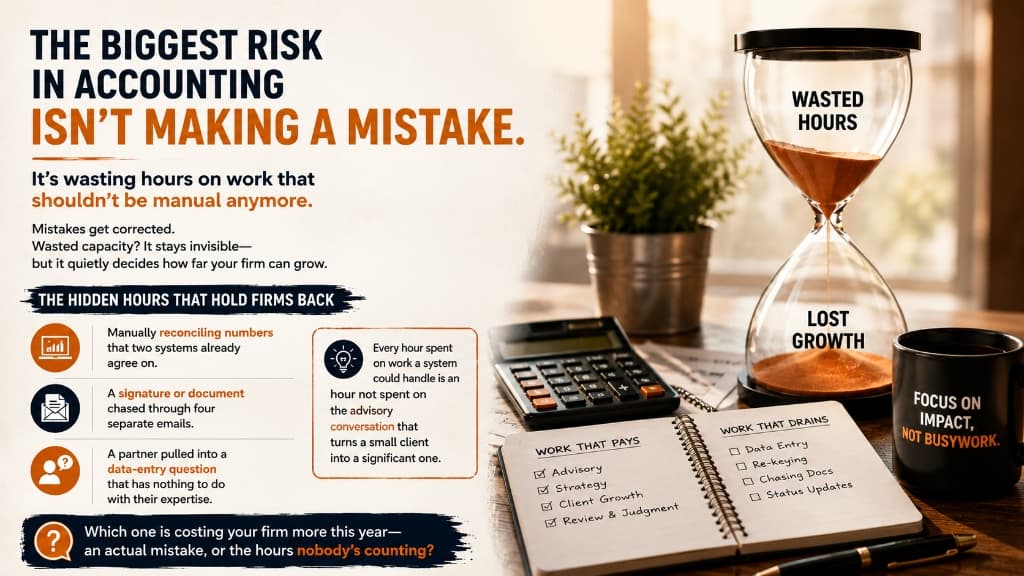
Ask a CPA firm to name their biggest risk, and you'll hear the same answers: a missed deadline, a compliance error, an audit finding, a client walking away after a bad experience. All real. All worth guarding against. But there's a quieter risk that rarely makes the list, because it never shows up as a single dramatic failure. It doesn't trigger an insurance claim or prompt a call from a regulatory body, yet it quietly erodes the firm's profitability and viability.
The Risk That Never Gets Named
This risk shows up as thousands of small, invisible hours. Hours spent manually keying data that already exists somewhere else. Hours reconciling spreadsheets by hand. Hours chasing signatures, documents, and approvals through endless email threads. None of it feels risky in the moment. It just feels like “the job.”
In many firms, staff members spend hours each day copying information from bank statements into accounting ledgers or hunting down client receipts. Because these activities are billable or absorbed into flat fees, partners assume they are productive. In reality, they represent wasted capacity that could be automated, creating a significant opportunity cost.
Where It Actually Costs the Firm
Zoom out, though, and the picture changes. Every hour spent on work a system could handle is an hour not spent on advisory conversations, tax planning, or the kind of client relationship that turns a small engagement into a significant one. That's not just a productivity issue. It's a growth ceiling, quietly built one manual task at a time.
Firms still doing this work by hand aren't less capable — they're often just running on processes designed for a smaller, simpler practice from years ago. What worked at five people rarely scales cleanly to fifteen, especially under peak-season pressure.
Why This Risk Stays Invisible
Mistakes are visible. They get caught, corrected, and remembered in the next partner meeting. Wasted capacity is invisible. Nobody flags it in a review, yet it quietly caps how much a firm can grow without burning out its best people. It also drives talent out of the firm; young accountants don't leave because the tax law is too hard, they leave because they are tired of being expensive data-entry clerks rather than strategic advisors.
What This Means for Your Firm
Maybe the better question for firm leaders isn't “where could we make an error?” It's “where are we still paying skilled people to do unskilled work?” That answer usually says more about a firm's future than any single mistake ever could — and firms that start asking it regularly tend to find capacity they didn't know they had, without adding a single new hire.