The argument about AI in tax has been an argument about accuracy for two years. The profession appears to have moved on without it.
The Three Conditions
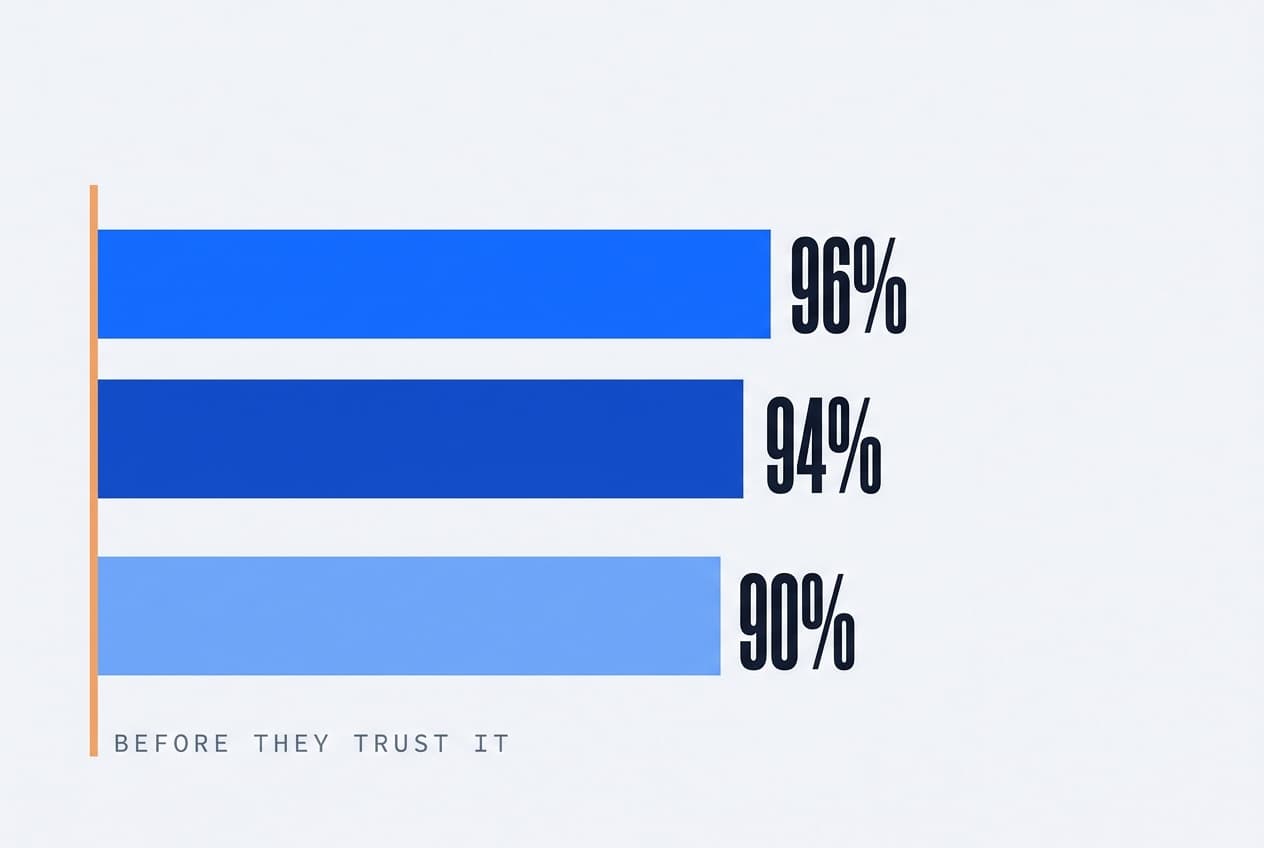
The Thomson Reuters 2026 State of Tax Professionals Report surveyed more than 600 respondents and asked what they would require before trusting AI with client work. Ninety-six percent said data confidentiality safeguards. Ninety-four percent said outputs grounded in authoritative content. Ninety percent said reasoning that is explainable and defensible.
Read those three together and they describe a single requirement: not that the answer is correct, but that its provenance can be established after the fact.
This is a very specific kind of scepticism, and it is not the one AI vendors usually answer. Accuracy claims address whether the output is right. These three address whether you can prove where it came from when somebody asks.
Why That Is the Right Question for This Profession
In most fields, a correct answer is sufficient. In tax it is the starting point.
A position on a return has to survive a reviewer, and possibly an examination, months or years after the person who took it has forgotten the reasoning. What makes it defensible is the trail: the authority relied on, the facts it was applied to, the judgment exercised in between. That trail is the work product, not a byproduct of it.
An answer that is correct but untraceable fails this test completely. It cannot go in a workpaper, because a workpaper is a record of reasoning rather than a record of conclusions. It does not survive a review, because review means checking the reasoning. And no practitioner is going to sign a return on the strength of something they cannot reconstruct.
So when 90% of respondents ask for explainable and defensible reasoning, they are not being cautious about a new tool. They are describing the existing standard of care and asking whether the tool clears it.
The Gap Between What Is Needed and What Is Available
The same report found that 41% of professionals lack access to AI tools that are actually built for professional work and grounded in verified content.
That is a striking number set against the adoption figures. Fifty-seven percent now cite AI as their top technology investment priority, up from 47% the year before. Only 11% report using no automation at all, down from 18%. The direction of travel is not in question.
But 44% automate no more than a quarter of their tax workflow, and 27% automate up to half. Depth has not followed breadth. Most firms have AI somewhere and have not put it anywhere load-bearing.
The trust conditions explain why. A tool that cannot show its sources is useful for drafting an email and unusable for a position on a return. Firms are not being slow; they are correctly declining to put an untraceable process in a place that requires a trace.
What Confidentiality Is Doing at the Top of That List
Ninety-six percent is close to unanimous, and it is the highest of the three conditions.
The reason is that a tax file is not merely sensitive, it is somebody else's. A practitioner holds it under an obligation, and the obligation does not have an exception for pasting an extract into a general-purpose chat window to save twenty minutes.
This is the quiet risk in most firms right now. It is rarely a decision anyone made. It is a staff member under deadline pressure who found something that worked, in a tool the firm never evaluated, with a client's information.
Grounded, Private, and Able to Show Its Work
The three conditions describe a fairly precise specification, and it is the one MetaWurks was built against.
Answers come from the firm's own documents rather than from general web knowledge. It ingests returns, statements, correspondence and scanned files, and retrieval runs across that set, so an answer is grounded in the practice's actual authority and workpapers rather than in whatever a model absorbed during training. On confidentiality, documents ingested into the platform are not used to train models or exposed to other users, with end-to-end encryption, single sign-on, role-based access matched to a staff member's engagements, and audit logs recording what was asked and by whom.
That last item is the one firms tend to undervalue until a reviewer asks a question about a busy Tuesday in February.
None of this removes the practitioner's judgment, and the professional standards do not permit it to. Due professional care remains with the CPA regardless of the tools used. What changes is how much of the day goes to assembling the basis for that judgment rather than exercising it.
Join the Conversation
The next time you rely on something an AI tool told you, could you show a reviewer where the answer came from, or only that it turned out to be right?