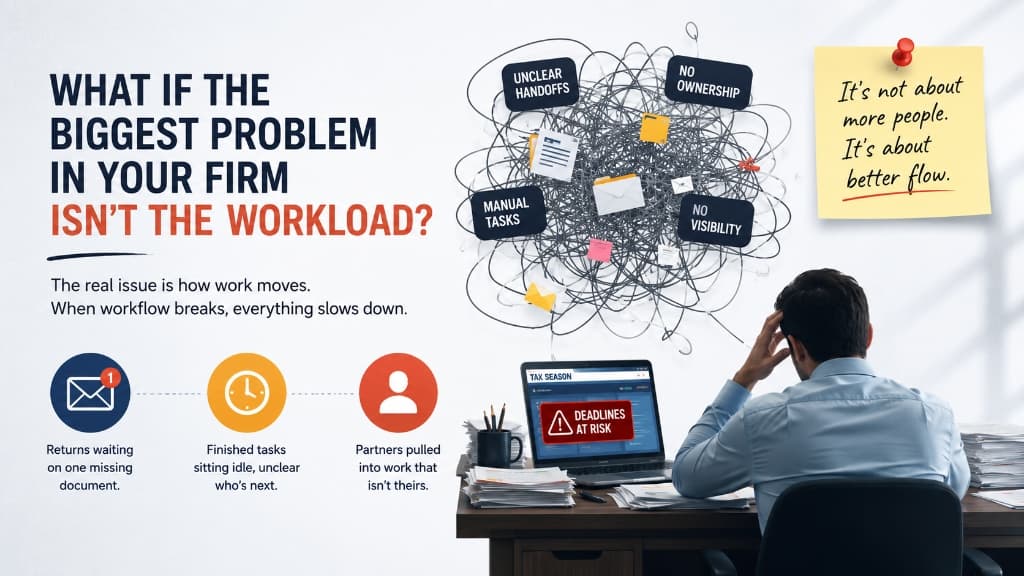
“We're just too busy” is the most common explanation for stress, delays, and burnout inside accounting firms. It's also, often, the wrong diagnosis. Two firms can have the exact same number of clients and the exact same deadlines. One moves through tax season in reasonable order, delivering returns on time and keeping team morale intact. The other feels like it's constantly on fire, with missed deadlines, errors, and an exhausted staff.
Workload vs. Workflow
The difference usually isn't how much work exists. It's how that work moves through the firm. In a lot of practices, work doesn't flow so much as it stalls. A return sits waiting on one missing document. A staff accountant finishes a task but isn't sure who reviews it next. A partner gets pulled into a data-entry question that has nothing to do with their expertise. None of these moments look like a crisis on their own. Together, they are the crisis.
That's the part that's easy to miss: workload is visible and easy to blame. Workflow is invisible, and much harder to fix, so it rarely gets questioned at all. When work accumulates in individual inboxes rather than a transparent, central pipeline, bottlenecks go unnoticed until it's too late.
Why “Just Hire More” Doesn't Work
Firms that feel permanently understaffed often aren't short on people. They're short on clarity: clear handoffs, clear status tracking, clear ownership of repetitive tasks that never needed a CPA's judgment in the first place. Add headcount to a firm like that, and the confusion just gets bigger, not smaller. More communication channels mean more opportunities for messages to get lost, and more handoffs increase the risk of delays and quality control lapses.
Mapping the Path Forward
Before assuming the answer is “hire more” or “say no to clients,” it's worth mapping how work actually moves from intake to delivery. Where does it stall? Where does the same information get requested twice? Where is a skilled person doing something a system should be doing instead? By establishing transparent status tracking and automatic task routing, you can eliminate the administrative friction that slows down returns, ensuring smoother operations and happier clients.
What This Means for Your Firm
Sometimes the workload was always manageable. It was the path the work traveled that never was — and fixing that path often does more for a firm's sanity than any amount of extra staffing ever could. In the end, operational efficiency is not just about technology; it's about building a firm that respects your team's time and delivers excellence to your clients consistently.