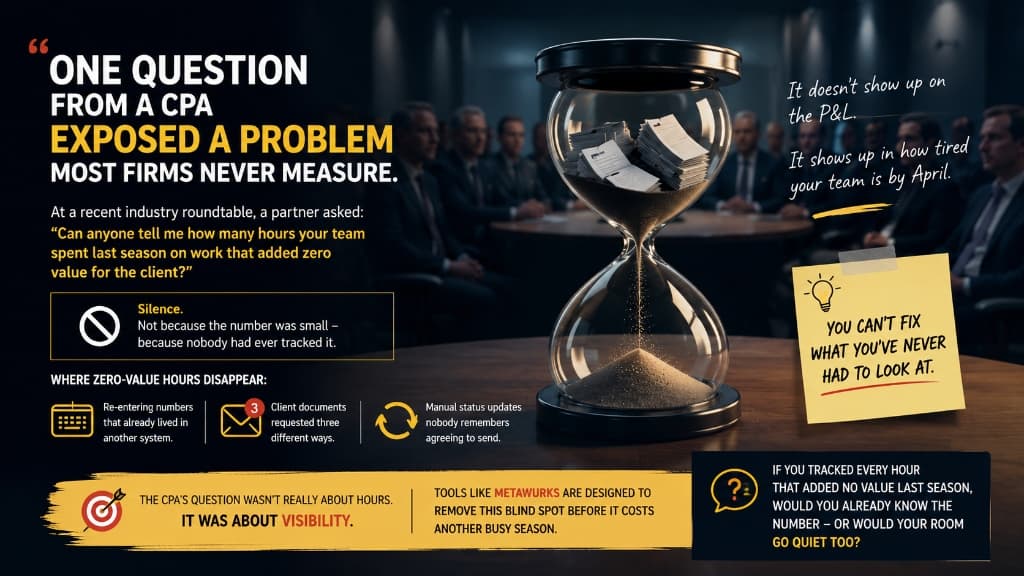
At a recent industry roundtable, a CPA firm partner asked a simple question to a room full of peers: “Can anyone here tell me how many hours your team spent last season on work that added zero value for the client?” Silence fell over the room. Not because the answer was small, but because nobody had ever tracked it. Every partner in the room knew their billable metrics, their realization rates, and their top-line revenue, but none could quantify their process waste. This silence highlighted a massive industry-wide blind spot that costs firms thousands of dollars in lost productivity and missed opportunities every year.
What Firms Measure — and What They Don't
Every firm in that room could report billable hours, realization rates, and revenue per partner down to the decimal. Ask them how many hours went to formatting, re-keying data, chasing documents, or fixing avoidable errors, and the tracking simply didn't exist. It't that the number was bad. It was that the number was invisible.
That's the uncomfortable part. Firms are exceptionally good at measuring what clients pay for. Almost none measure what quietly eats into the time available to earn that pay in the first place. You can't fix what you've never had to look at, and most firms have never had to look at this, because no report forces them to. This blind spot is why many firms continue to rely on manual, outdated workflows, unaware of the structural inefficiencies that drain their margins and exhaust their staff members.
Turning an Invisible Number Into Real Capacity
The CPA's question wasn't really about hours. It was about visibility. Once a firm starts measuring non-value-add work, it's hard to unsee it: the duplicate data entry, the manual status updates, the same client document requested three different ways by three different people.
When you categorize and track these hours, they stop being “administrative overhead” and start being “recoverable capacity.” For a ten-person firm, saving just three hours of administrative work per person per week is equivalent to gaining an entire full-time employee during the busy season—without the cost or overhead of hiring. It allows your staff to focus on higher-value advisory services, which clients actually appreciate and pay premiums for, driving the firm's growth and increasing employee satisfaction.
What This Means for Your Firm
So here's the same question, worth asking inside your own firm: if you tracked every hour that added no value to the client last season, would you already know the answer, or would the room go quiet too? Identifying and automating those zero-value tasks is the fastest way to build a more resilient, profitable firm. It turns wasted effort into bottom-line profits and happier employees. In a market where talent acquisition is increasingly competitive, protecting your team from burnout is a critical strategic advantage. By taking this step, you can reclaim your time and build a firm optimized for the modern accounting landscape.