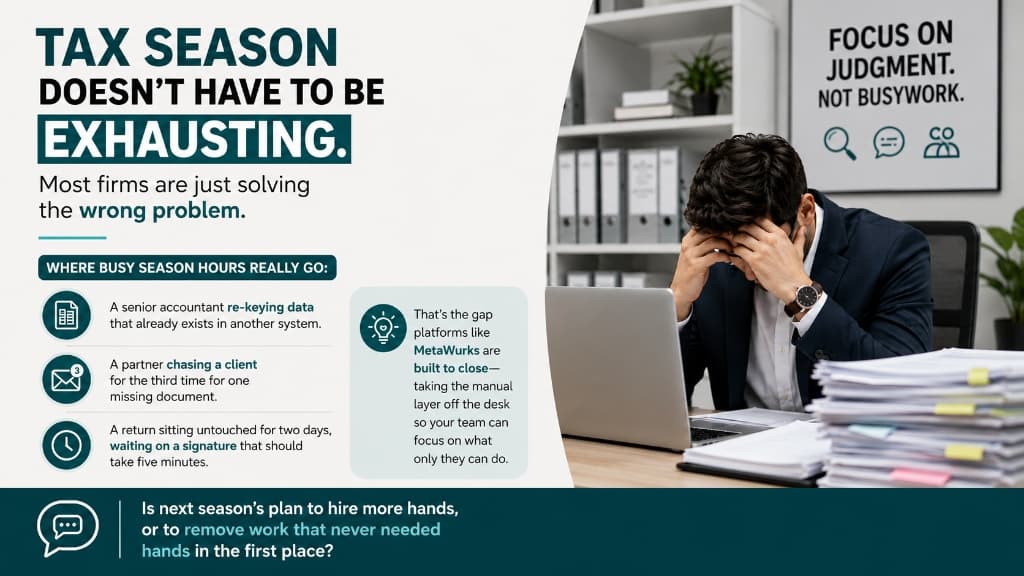
Every year, the same conversation happens inside accounting firms: “We need more hands.” More seasonal staff, more overtime, more coffee. It feels logical — more work should mean more people. But look closer at where the hours actually go, and a different problem shows up entirely. The gap between firms that feel overwhelmed and those that operate smoothly during tax season isn't a matter of headcount. It's a matter of process.
Where the Hours Actually Go
A large share of the busiest weeks isn't spent on judgment, analysis, or client strategy — the work CPAs are trained and paid for. Instead, it is spent chasing missing documents, re-entering the same client data across systems, formatting workpapers, and answering “where do I upload this?” for the fifth time that day. None of that is technical work. All of it is exhausting, and none of it requires a CPA's expertise to complete.
Firms spend up to 40% of their billable hours during tax season on administrative friction rather than actual preparation and advisory work. That's not a headcount problem. That's a process problem wearing a headcount costume. When you hire more people to solve this, you are simply adding more coordinators to manage the inefficiency, compounding the communication overhead.
Why Adding People Doesn't Fix It
Adding people to a broken workflow doesn't fix the workflow — it just adds more people to the chaos. Training takes time, seasonal hires make mistakes under pressure, and partners end up reviewing more, not less. The exhaustion doesn't disappear. It just gets distributed across more desks, more inboxes, and more late nights.
Furthermore, onboarding temporary staff during the busiest months of the year introduces security risks and quality control challenges. With client files flying across emails and portals, maintaining strict data governance becomes an uphill battle, increasing the likelihood of regulatory issues and compromised client trust.
What the Lighter Firms Do Differently
The firms that actually feel lighter during tax season aren't the ones with the biggest bench. They're the ones that went back and asked a harder question: how much of this work should even be manual at this point?
Document collection, data entry, status updates, reconciliation — these are exactly the tasks that no longer need a human doing them by hand, one at a time. By implementing intelligent workflow orchestration platforms, modern firms automate the retrieval of client documents, verify their completeness against check-lists, and extract data directly into tax software. Once that layer gets lighter, the people already on staff can focus on the work that actually needs their expertise: advisory conversations, technical review, and the client relationships that justify what they're paid to do.
What This Means for Your Firm
The problem was never the workload. It was what kind of work was filling the hours. Before the next busy season starts, it's worth asking, honestly: are you hiring for the volume of work, or the type of work? Getting that answer right is often the difference between another exhausting season and one your team can actually sustain.